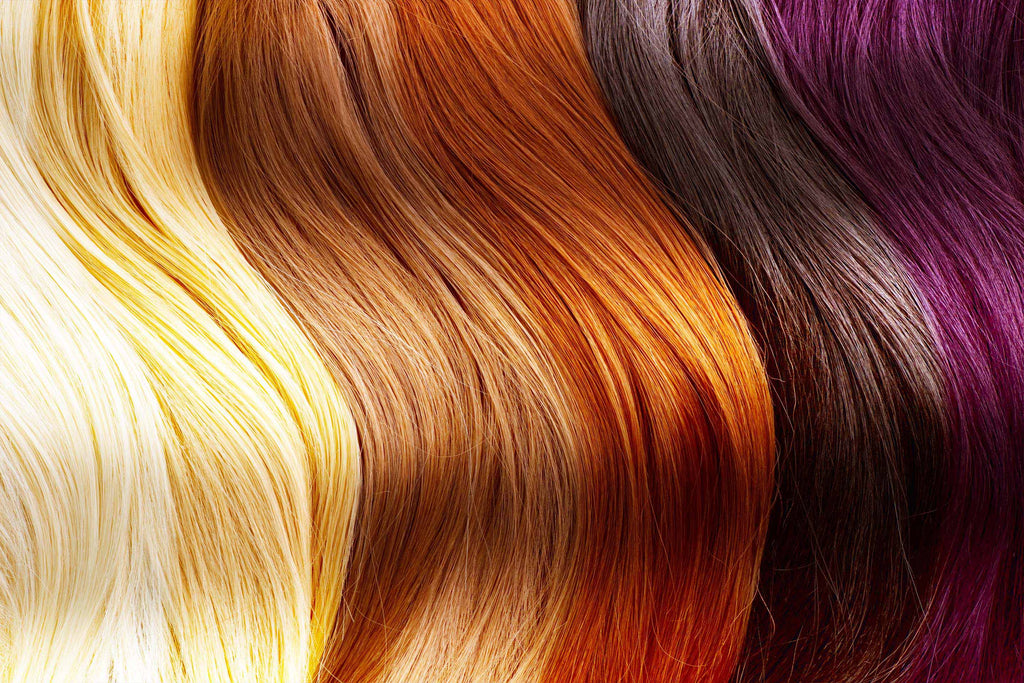
Today, companies have formulated color that is controlled by extremely subtle and fine-tuned chemistry, but we have craved to express ourselves with color in our hair since ancient times. In fact, researches analyzing hair from Rameses II in Egypt discovered that they used to color their hair with henna. The Greeks and Romans? Well, they used vegetable extracts derived from walnuts and elderberries, as well as minerals and metals such as lead, mercury or copper, and even animal matter in the form of burnt ant's eggs! It wasn’t until the 19th century that hair color, as we know it today when pigments first used in the dyeing of wool, began to be adapted for coloring human hair.
Thankfully we’ve come a long way since then! While technology has changed, the desire has not. Today every gal loves to express herself in color, sometimes it’s by adding a few highlights or lowlights to give you that dimensional hair look that is so trendy in Hollywood. When it colored hair extensions, 100% Human Remy Hair is no different in terms of the color process, but not every company is the same in their method.
HOW WE ACHIEVE PERFECT PIGMENTS
We take great pride in our 6 step process to ensure that when WE color your hair you get a Perfect Pigment every time!
- STEP 1: It starts by using real human hair. We purchase our Remy hair direct from the temples in India where it is collected during the tonsure ritual. This process is essentially selecting bundles of hair from large collected lots, but not all hair donated by the women during the ritual is the same.
- STEP 2: We carefully select visually different bundles of hair to identify the healthiest hair to start with. This ensures not only that the hair that makes its way to you is the best, but also that it holds on to color for the longest period of time. Healthy hair keeps color longer…it’s that simple.
- STEP 3: At our factory, we carefully sort hair by natural tones. During most of the months of the year, Indian hair can vary from dark black to medium brown, but during the summer the hair will be lighter from the sun. We separate the bundles with lighter hair and ideally, grey hair is used to create lighter shades with all other bundles being used for darker shades.
- STEP 4: Many companies will use harsh pigments, heavily laden with chemicals that not only fade fast but also will destroy the hair cuticle just like it would your own hair. We take great pride in a careful coloring process that treats your add-on hair as gently as if it was attached to your head. For darker shades, we employ a direct coloring process to achieve the deepest and richest tones. When it comes to lighter colors, we take that process one step further…
- STEP 5: When it comes to bleaching, our selection process for hair becomes incredibly important as healthier hair handles chemical processing with less long term damage than already damaged hair. We start in small batches, bleaching the lighter color hair, or ideally grey hair that is naturally losing melanin. As the process occurs, we continually check the integrity of the strands to ensure that during removal of the pigment that hair isn’t becoming damaged. If it is, we toss it from the batch!
- STEP 6: Once the hair is prepped for color, we color it the same way a stylist does in a salon or you do at home, but the color we use matters! Our gentle hair color will deliver buttery blondes or rich chestnuts with deeper, rich tonality and shine without relying on harsh chemicals.
While time has moved on since the days when we’d be processing with henna, we treat your hair no differently than you were sitting in our chair and we were coloring it on your head. In other words, our commitment to quality is geared to have you look in the mirror at your new look and simply say, “Perfect!”
Coloring Hair Extensions: What You Need to Know
"Color is where we spend the most time with customers during consultations. Getting the color right is the single most important factor in natural-looking extensions. The process of finding the right match - or adjusting an existing set - requires understanding both your natural hair and the extension hair."
- Priyanka Swamy, Founder of Perfect Locks
Our Color Matching Process
Photograph in natural light
The most common color matching mistake is using indoor photos or direct flash. Natural daylight is the only reliable light source for accurate color assessment. Take your reference photo outside, away from direct shade, on an overcast day (which diffuses light evenly) or in open shade.
Identify your undertone
Beyond the obvious light-to-dark spectrum, hair color has warm undertones (golden, red, copper), cool undertones (ash, beige, blue-black), or neutral undertones. Matching the undertone matters as much as matching the depth. An ash blonde extension on warm golden blonde natural hair creates an obvious mismatch even if the lightness level is identical.
Consider your ends vs. roots
Most natural hair has some variation between roots and ends - whether from sun exposure, previous color, or natural lightening at the tips. Extensions are one uniform color throughout. For the most natural blend, match the extension color to the mid-lengths of your hair rather than the roots or the ends.
Use our free color match service
Send us your natural light photo and we'll recommend the closest color from our range. Our team matches hundreds of customers monthly and has developed significant expertise in identifying which of our shades corresponds to which natural hair variations. This service is always free.
Test before committing to a full set
If you're uncertain between two colors, start with a single weft in your top choice before purchasing the full set. A single weft is a small investment to confirm the match is right before you commit to all pieces.
Adjust if needed
Extensions that are slightly too dark can be toned lighter by a colorist. Extensions that are slightly too warm can be toned cooler with a purple or blue-based toner. Minor adjustments are significantly easier than major color changes - the closer your initial selection, the less adjustment work is needed.
Frequently Asked Questions
How do I match my hair extension color?
Photograph your natural hair in natural daylight (not indoor lighting). Identify both the depth (how light or dark) and the undertone (warm, cool, or neutral). Use our free color matching service - send your natural light photo and our team recommends the correct shade. When between two options, match to your mid-lengths rather than roots or ends.
What if my extension color doesn't match?
Extensions slightly too dark: a colorist can tone or lighten carefully. Extensions slightly too warm: blue or purple-based toner cools the undertone. Extensions too light: semi-permanent color or toner can darken. We also have a 30-day return policy if the color simply isn't right - reaching out to our team is always the first step.